

5 Signs It's Time to Move From Drums to IBCs
30th Sep 2026
If your business stores, transports or dispenses bulk liquids, there may come a point where drums are no longer the most efficient solution.
Most people know Plasdene for bottles, jars and closures, but we also supply large-scale packaging solutions for businesses working with bulk liquids.
One option that's growing in popularity across many industries is the Intermediate Bulk Container, or IBC.
Designed to safely store and transport up to 1000L of liquid in a single unit, IBCs can help improve efficiency, reduce handling and make better use of warehouse space.
So how do you know whether it's time to upgrade from drums to IBCs?
First Things First: What Is An IBC?
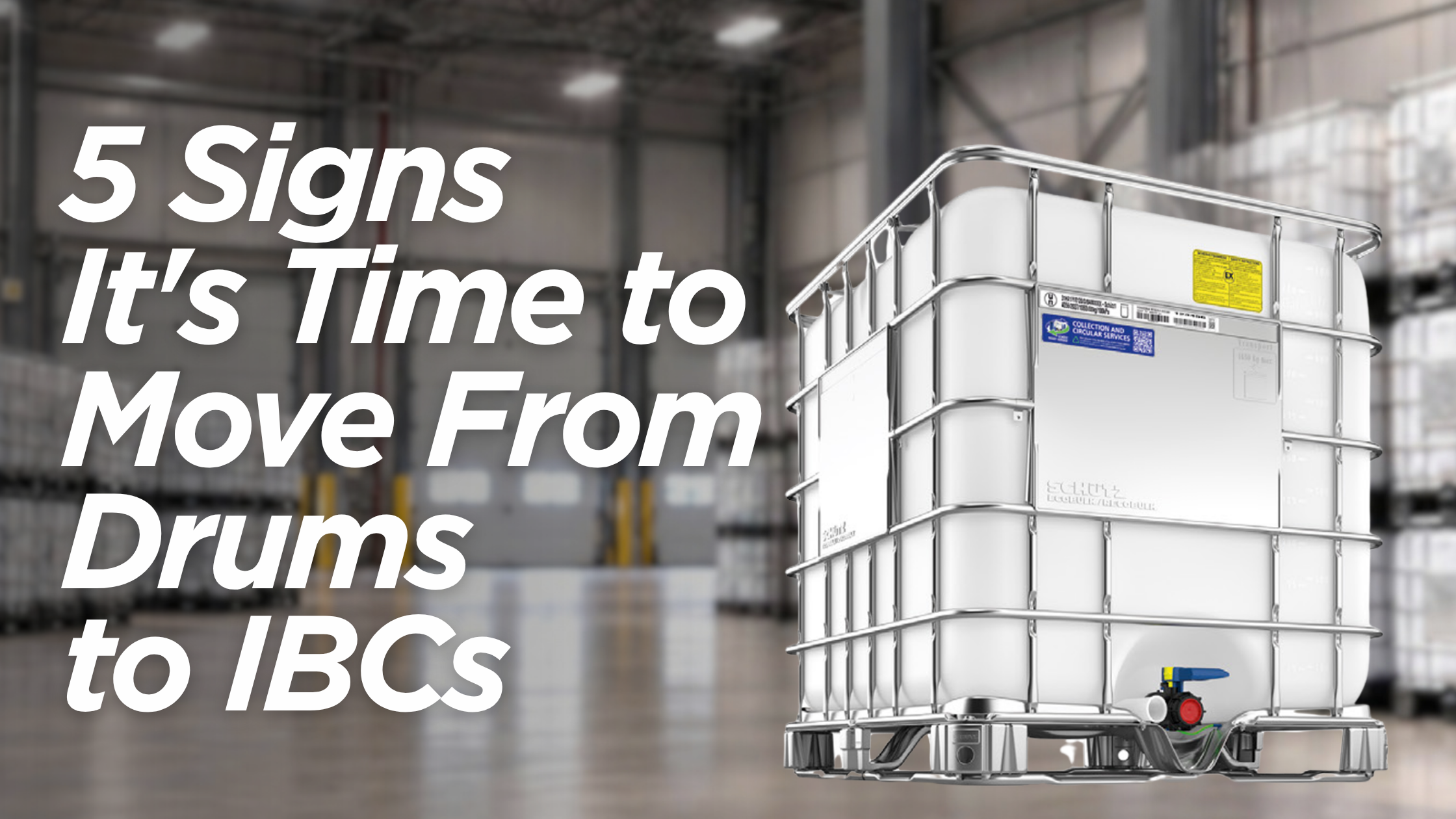
An Intermediate Bulk Container (IBC) is a reusable industrial container designed for storing and transporting bulk liquids.
Most commonly seen in 1000L capacities, IBCs feature a food-grade HDPE inner bottle protected by a galvanised steel cage and integrated pallet, making them easy to move, stack and handle.
They're used across industries including food and beverage, chemicals, cosmetics, agriculture, mining and manufacturing.
Sign #1: You're Managing Multiple Drums For The Same Product
If you're storing 800L, 1000L or more of the same liquid, managing multiple drums can quickly become inefficient.
A single 1000L IBC can replace several drums, reducing handling, simplifying inventory management and helping to keep workspaces more organised.
The fewer containers your team has to move, monitor and manage, the more efficient day-to-day operations become.
Sign #2: Warehouse Space Is Becoming A Problem
Warehouse space is valuable.
Unlike drums, IBCs are designed with efficiency in mind. Their square footprint makes better use of storage areas and allows for safer, more effective stacking.
For businesses looking to maximise available warehouse space without expanding storage facilities, switching to IBCs can be a simple but effective improvement.
Sign #3: Filling And Dispensing Takes Too Long
Every additional drum creates another touchpoint in your process.
IBCs feature a large filling opening and integrated discharge valve, allowing product to be filled, stored and dispensed more efficiently.
For manufacturers regularly transferring liquid ingredients, raw materials or finished products, this can help reduce handling time and improve productivity.
Sign #4: You Need Food-Grade Or Dangerous Goods Compliance
Not all liquid products have the same requirements.
Whether you're storing food ingredients, beverage concentrates, industrial chemicals or dangerous goods, ensuring compliance is critical.
IBCs supplied by Plasdene are available in both FoodCert and Dangerous Goods-approved configurations, helping businesses meet regulatory and operational requirements with confidence.
Sign #5: Sustainability Is Becoming A Business Priority
Sustainability is playing an increasingly important role in packaging decisions across all industries.
SCHÜTZ supports a circular packaging model through its global collection and reconditioning programs. Used IBCs can be collected, reconditioned and returned to service, helping to reduce waste and extend packaging life.
For businesses looking to improve their environmental credentials, this provides a practical alternative to single-use packaging systems.
Why Choose IBCs?
When businesses make the move to IBCs, they are often looking for more than just a larger container.
They're looking for:
- Improved warehouse efficiency
- Reduced handling time
- Food-grade and dangerous goods options
- Strong product protection
- Sustainability support
We Don't Just Do Bottles & Jars
Many customers are surprised to learn that Plasdene supplies industrial bulk packaging solutions alongside our extensive range of bottles, jars, pails and closures.
Whether you're handling food ingredients, chemicals, cosmetics or industrial liquids, our team can help identify the right bulk packaging solution for your operation.
And unlike many suppliers, we can supply IBCs from as little as one unit.
Need Something Bigger?
Talk to our team about IBCs and discover whether moving from drums to IBCs could help improve efficiency across your business.